Hiring in South America can reduce your hiring costs while keeping your team close to North American working hours. The right country depends on the role, language, salary band, and employment model, not on a single cheapest-country ranking.
Let's talk about your hiring need
15 minutes to scope the role and see what a remote team could look like.
This guide compares hiring costs in South America by country, explains the main compliance choices, and shows where Colombia, Argentina, Brazil, and Chile fit best.
What makes South America a strong hiring market?
South America gives international employers access to professionals who can often work with North American teams during overlapping business hours. Colombia, Argentina, Brazil, and Chile are the main markets to compare, but each one has a different talent profile and employment process.
For a company hiring remotely, the practical advantages are:
- Time-zone overlap: Colombia uses Eastern Time year-round, while Argentina, Brazil, and Chile are generally within a few hours of Eastern Time.
- Role diversity: The region supports software engineering, sales, customer support, finance, marketing, operations, and executive roles.
- Flexible hiring models: You can hire an independent contractor, work with a recruitment partner, employ through an employer of record (EOR), or create a local entity.
- Language coverage: Spanish is common in Colombia, Argentina, and Chile. Brazil’s working language is Portuguese. English ability varies by role, seniority, and city.
The best result comes from matching the country to the role before you discuss compensation.
South America hiring costs by country
There is no reliable single salary for a country. Employer cost changes with seniority, city, language requirements, benefits, exchange rates, employment status, and local contributions. Use the ranges below as planning estimates, then validate the final package with a local payroll or employment specialist.
Colombia hiring costs
Colombia is often a practical starting point for sales, customer support, marketing, and operations roles. Bogotá and Medellín offer established professional and technology communities, with candidates available for teams that need Spanish and English coverage.
Typical planning ranges from the existing Conexo benchmark are:
| Role | Monthly planning range | Annual planning range |
|---|---|---|
| Sales Development Representative | $1,200 to $1,800 | $14,400 to $21,600 |
| Customer Support Specialist | $900 to $1,400 | $10,800 to $16,800 |
| Marketing Coordinator | $1,100 to $1,700 | $13,200 to $20,400 |
| Mid-level Software Engineer | $2,500 to $3,800 | $30,000 to $45,600 |
| Finance or Accounting Analyst | $1,400 to $2,200 | $16,800 to $26,400 |
Treat these as salary-planning figures, not a legal quote. Your real employee recruitment cost in South America also includes benefits, paid leave, statutory contributions, payroll administration, equipment, and any recruitment fee.
Argentina hiring costs
Argentina is a strong market for software engineers, data specialists, product managers, DevOps engineers, and designers. Compensation planning needs extra care because currency conditions can change quickly and many experienced professionals prefer compensation linked to a stable currency.
| Role | Monthly planning range | Annual planning range |
|---|---|---|
| Mid-level Software Engineer | $2,200 to $3,500 | $26,400 to $42,000 |
| Data Engineer or Analyst | $2,500 to $4,000 | $30,000 to $48,000 |
| Product Manager | $3,000 to $5,000 | $36,000 to $60,000 |
| DevOps Engineer | $2,800 to $4,200 | $33,600 to $50,400 |
| Graphic Designer | $1,200 to $2,000 | $14,400 to $24,000 |
Argentina hiring cost should be modeled with legal advice. An EOR can be a simpler route when you need an employee relationship but don't have an Argentine entity.
Brazil hiring costs
Brazil has the largest talent pool of the four markets, but it also requires careful employment planning. The Brazilian Ministry of Labour and Employment provides the official government starting point for labour rules and employer services.
The existing benchmark estimates these all-in monthly ranges:
| Role | Monthly all-in planning range | Annual all-in planning range |
|---|---|---|
| Mid-level Software Engineer | $3,500 to $5,500 | $42,000 to $66,000 |
| Bilingual Customer Support Specialist | $1,200 to $1,800 | $14,400 to $21,600 |
| Sales Manager | $3,000 to $4,500 | $36,000 to $54,000 |
| Finance Analyst | $1,800 to $2,800 | $21,600 to $33,600 |
| Operations Coordinator | $1,400 to $2,200 | $16,800 to $26,400 |
Brazil’s CLT employment framework includes obligations such as FGTS, social security contributions, and the 13th-month salary. Don't turn a salary estimate into a promise about total employer cost until a local expert confirms the role and contract structure.
Chile hiring costs
Chile is a good fit for senior finance, legal, operations, and executive roles. Santiago has a mature professional-services market, so senior candidates can cost more than comparable hires in Colombia or Argentina.
| Role | Monthly planning range | Annual planning range |
|---|---|---|
| CFO or Finance Director | $5,000 to $9,000 | $60,000 to $108,000 |
| Legal Analyst | $2,500 to $4,000 | $30,000 to $48,000 |
| Senior Software Engineer | $3,500 to $5,500 | $42,000 to $66,000 |
| Marketing Manager | $2,500 to $4,000 | $30,000 to $48,000 |
| Executive Assistant | $1,500 to $2,500 | $18,000 to $30,000 |
Chile hiring costs are easier to plan when you define the seniority, benefits, and employment relationship first. A local payroll review still matters before you issue an offer.
Which South American country is best for your role?
The best country depends on the work you need done:
| Hiring need | Best starting market | Why |
|---|---|---|
| Sales, support, and operations | Colombia | Strong fit for customer-facing and bilingual roles |
| Engineering, product, and design | Argentina | Deep technical and product talent in major cities |
| Larger teams and broad functions | Brazil | The region’s largest professional talent pool |
| Finance, legal, and executive roles | Chile | Mature professional-services market |
This is a starting point, not a restriction. A strong candidate can be anywhere, and language or industry experience may matter more than country.
Three ways to hire in South America
1. Independent contractor
A contractor arrangement can work for a genuinely independent consultant or a short project. It is not a shortcut for an employee relationship. If you control the person’s schedule, work, tools, and day-to-day responsibilities, ask a local adviser to assess misclassification risk.
2. Recruitment agency or staffing partner
A recruitment agency sources and screens candidates, coordinates interviews, and may support the offer or onboarding. Ask for the fee structure, replacement terms, candidate ownership rules, and who handles payroll after the hire.
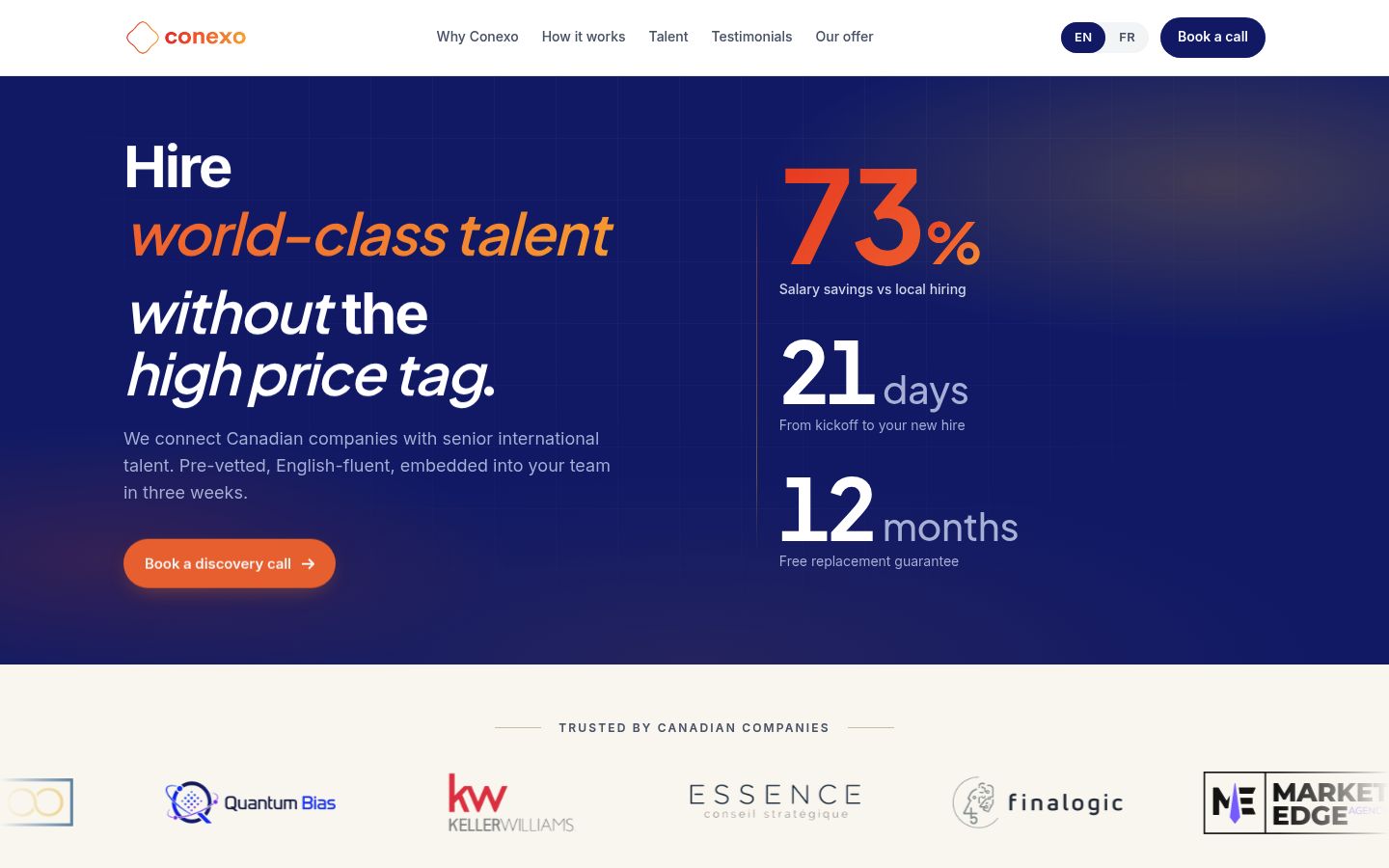
Conexo hires English- and French-speaking professionals from more than 50 countries, with a strong presence across South America and other international talent markets. Its offer covers sourcing, practical screening, payroll and HR administration, a first shortlist in three to four weeks, and a 12-month replacement guarantee. See Conexo’s offer for current terms, including the published $11 to $19 CAD per hour range for specialized expertise and the separate recruitment fee.
3. Employer of record
An EOR becomes the legal employer in the target country. It normally handles the employment contract, payroll, benefits administration, tax processes, and local compliance while your company manages the employee’s daily work.
The main EOR options named in the original page are Deel, Remote, and Oyster. Their official pricing pages show that EOR fees are product- and country-specific, so don't assume a generic $300 to $650 monthly range:
- Remote pricing lists Employer of Record at $699 per employee per month, Contractor Management at $29 per contractor per month, and Contractor of Record from $325 per contractor per month.
- Oyster pricing lists Employer of Record at $699 per employee per month and Global Contractors at $29 per contractor per month after its introductory period.
- Deel’s public pricing page was not accessible for verification during this rewrite, so confirm the current fee directly on Deel’s official site before budgeting.
The EOR fee is only one part of the cost. Add salary, benefits, employer contributions, currency conversion, equipment, and any deposit or country-specific charge.
How long does it take to hire in South America?
Plan for three to five weeks from a clear role brief to a start date when a recruitment partner already has local networks. The timeline usually looks like this:
- Brief and sourcing: Define outcomes, language, working hours, salary range, and the employment model.
- Screening: Review skills, communication, work history, and right-to-work or contractor documentation.
- Interviews: Run focused interviews and a practical assessment tied to the actual job.
- Offer and compliance: Confirm compensation, benefits, contract terms, payroll, and onboarding.
- First month: Set goals, schedule manager check-ins, and make sure the new hire has the tools to work.
A job board can produce volume. It won't always give you the local screening, compliance judgment, or passive-candidate access that a regional recruitment partner provides.
Common mistakes when hiring in South America
Comparing salary instead of total employer cost. Add statutory contributions, benefits, payroll, recruitment, equipment, and currency costs before comparing countries.
Treating every contractor as low risk. A contractor label doesn't remove employment obligations. Review control, permanence, exclusivity, and reporting lines with local counsel.
Using one compensation rule across the region. The same role can have different market rates, benefits expectations, language requirements, and currency preferences in Colombia, Argentina, Brazil, and Chile.
Skipping the onboarding plan. Remote hiring works better when the manager sets written outcomes, gives the person context, and checks in during the first month.
FAQ
What is the cost to hire in South America?
The cost to hire in South America depends on the country, role, seniority, and employment model. Planning ranges in this guide run from about $900 per month for a Colombian customer support role to $9,000 per month for a Chilean finance director, before you confirm benefits and local obligations.
What are hiring costs in South America by country?
Colombia is often the lowest-cost starting market for sales, support, and operations. Argentina is a strong technical market, Brazil offers the broadest talent pool but needs careful compliance planning, and Chile usually carries a premium for senior professional roles.
What is the cheapest country to hire in South America?
Colombia is often the cheapest country to hire in South America for non-engineering roles, but the lowest salary isn't always the lowest total cost. Language, replacement risk, benefits, payroll, and the cost of managing compliance can change the result.
What is the Brazil hiring cost for a remote employee?
The existing benchmark places a mid-level Brazilian software engineer at $3,500 to $5,500 per month all-in for planning. Confirm the current package with a Brazil employment specialist because CLT obligations, benefits, exchange rates, and contract structure affect the final employer cost.
What is the Argentina hiring cost for a software engineer?
The planning range in this guide is $2,200 to $3,500 per month for a mid-level software engineer in Argentina. Currency expectations and employee protections make the contract structure just as important as the headline salary.
Is an EOR better than a recruitment agency in South America?
They solve different problems. A recruitment agency finds and screens people, while an EOR employs the person and manages local payroll and compliance. You can use both when you need a recruiter to find the candidate and an EOR to employ them.
How does Conexo help companies hire in South America?
Conexo recruits English- and French-speaking professionals from more than 50 countries worldwide, including Colombia, Argentina, Brazil, and Chile. It manages sourcing, payroll, HR administration, and onboarding, with a first wave of candidates in three to four weeks and a 12-month replacement guarantee.
Sources & References
- Conexo offer: current service terms and pricing structure
- Brazilian Ministry of Labour and Employment: official labour and employer resources
- Remote pricing: current EOR and contractor pricing
- Oyster pricing: current EOR and contractor pricing
- Hire With Near: regional hiring context cited in the original page
- Deel: official product reference; pricing not independently verified here
If you want to compare a role, country, and hiring model, talk to Conexo. It works with companies worldwide that want to hire international talent, not only companies in one country.